
Food Waste Recycling Cardiff: 2026 Price Guide
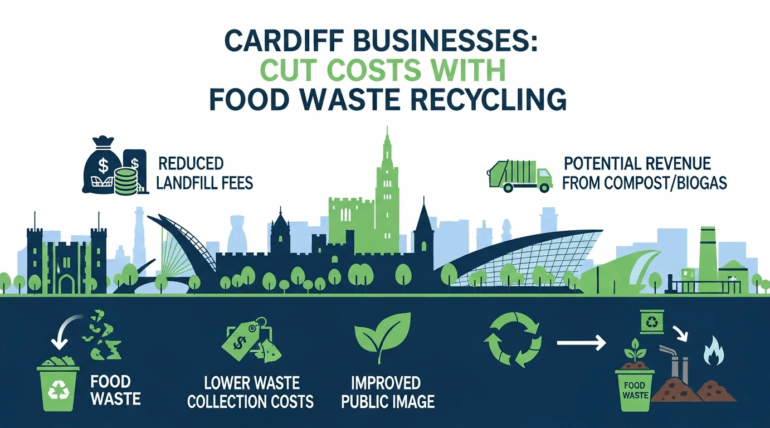
Hospitality venues in South Wales often pay twice for food waste. First, you spend money when buying raw stock. Consequently, you pay again when throwing it into heavy bins. However, switching to a dedicated food waste recycling Cardiff service can change this. As a result, your business can significantly cut monthly overheads.
Organic waste makes up 40% to 60% of commercial bin volume in restaurants and hotels. Therefore, leaving these heavy items inside general bins creates severe financial loss. This happens because general waste pricing includes heavy water weight. Thus, food waste becomes a hidden profit leak for local canteens.
New Welsh Environmental Laws For Businesses
The legal rules for commercial refuse in South Wales changed recently. Now, Natural Resources Wales strictly enforces these environmental laws. Therefore, all corporate enterprises must separate organic food leftovers from general waste before collection.
Mixing kitchen prep waste into general skips causes serious financial penalties. For instance, commercial carriers charge direct contamination fees from £20 to £100 per lift. Furthermore, continuous violations can lead to formal enforcement notices from the Environment Agency.
Estimated Food Waste Collection Costs in Cardiff
We have outlined the standard commercial pricing structures active across Cardiff below. Consequently, this data will help you audit your company expenses:
-
- 240 Litre Food Bin: It costs £8.00 to £20.00 per single lift.
- Small Business Contract: The monthly average ranges between £35.00 and £75.00.
- High-Volume Hotel Setup: Daily pickups can cost £150.00 to £400.00+ per month.
Segregated organic waste goes directly to anaerobic digestion plants. Afterward, processors convert it into renewable green energy. Therefore, processing food waste costs much less than sending wet trash to standard landfills.
Step-by-Step Food Waste Optimization
You can lower your monthly commercial refuse bill by taking three practical steps:
-
- Request a Custom Waste Audit: Reviewing your exact weekly container weight reveals immediate saving avenues. Therefore, you can avoid paying for underfilled lifts.
- Deploy Internal Caddies: Use clearly labeled, colour-coded caddies within canteens and prep lines. As a result, your team can easily eliminate accidental mixing.
- Control Kitchen Overproduction: Fine-tuning your raw stock management reduces waste before it ever reaches a commercial bin. Consequently, your overall efficiency increases.
FAQ: Commercial Food Waste and Compliance
Q1. Can we mix compostable packaging with food waste?
No, you cannot. Packaging labeled ‘compostable’ or ‘biodegradable’ cannot enter standard food bins. Therefore, you must treat these items as residual waste. Alternatively, you can arrange a dedicated collection. However, standard caddy liners are fully permitted.
Q2. How often should hotels collect food waste bins?
Private carriers recommend a weekly or fortnightly collection cycle. For that reason, you can proactively prevent strong odors and unwanted pests around your kitchen.
Q3. Why is food recycling cheaper than general waste collection?
General commercial waste incurs standard UK landfill taxes. Therefore, heavy residual bins are extremely costly to haul. However, routing organic weight to green compost structures instantly drops your baseline monthly invoices.
Conclusion
Setting up a compliant food waste recycling Cardiff blueprint helps turn a heavy liability into an asset. In addition, right-sizing your scheduled collections helps you hit Welsh sustainability targets smoothly.
Do you want to stop high contamination fees and cut corporate expenditures? You can save capital today by reviewing our professional waste management services. Contact our licensed Cardiff customer service team today to book your free corporate waste audit.
